How to Use a Jigger for Consistent Cocktails
Choose readable measures, avoid unit confusion and practise a repeatable jigger pour for cocktails that stay balanced from one serving to the next.
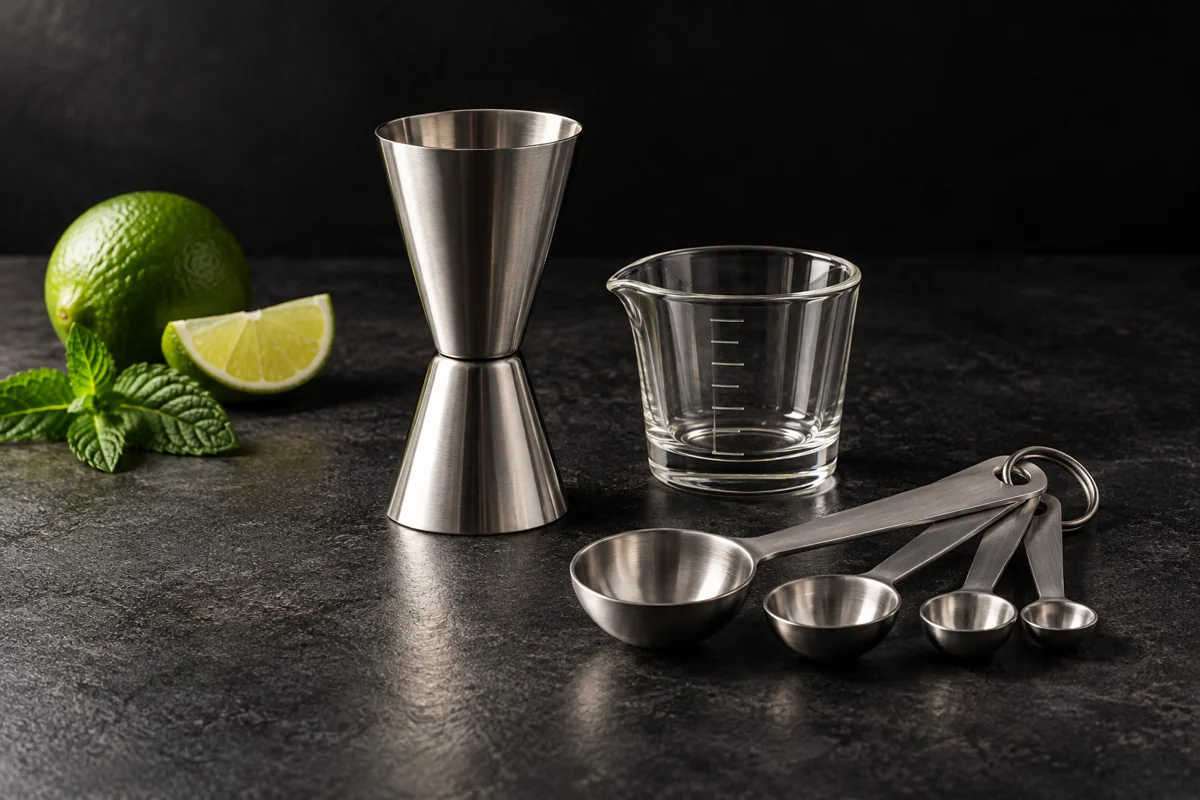
A small tool with a precise job
A jigger gives a recipe a repeatable volume. That sounds modest, but it makes every other development decision easier: you can judge sweetness, compare ingredients and scale a drink only when you know what went into it. A beautiful free-pour is not a substitute for a known measurement during recipe testing. At home, measuring also helps you avoid accidentally changing the strength of a serve.
Choose the tool around the amounts you actually use. A jigger with impressive styling but unclear internal marks may be less useful than a simple cup you can read comfortably. You do not need every measurement on one tool, but you do need a deliberate way to measure the smallest meaningful amount in the recipe.
Read the units before the numbers
Millilitres describe volume. Grams describe mass. A recipe written in fluid ounces uses a volume unit, while an ounce on a scale is a mass unit. NIST's kitchen guidance distinguishes these measures and provides approximate household equivalents. Do not move a number from one system to another simply because the label looks familiar.
For a recipe developed in millilitres, use its millilitre amounts consistently. If you convert an entire specification, use one documented conversion convention rather than rounding each ingredient differently from memory. A familiar 30 ml kitchen approximation for a fluid ounce can be practical, but label the result as a rounded conversion. Precision in the notes should match the equipment you are using.
Inspect every mark on a new tool
Before the first cocktail, fill the jigger with water and identify the lines you expect to use. Some tools mark internal steps; others rely on filling a cup to its brim. Angled measuring designs let you read from above, as OXO's official description explains. A traditional narrow jigger may require a different viewing position. Learn the tool's intended reading method rather than inventing one in the middle of service.
Check the manufacturer's stated measures and care instructions. Do not assume that both ends correspond to the familiar pair you used on a previous tool. Also avoid treating an unmarked shaker cap as a known measure. If its volume is not specified or verified, it is a cap, not a dependable jigger.
Make the pour controlled and repeatable
Set up so the jigger can be held steadily over the receiving vessel without blocking your view. Pour slowly as the liquid approaches the intended mark. Keep the tool at a consistent angle while reading it, then transfer the liquid cleanly. Practise with water until you can reach the mark without repeatedly overfilling and discarding the excess.
For thick ingredients, specify the preparation first. Honey, rich syrup and a diluted honey syrup are different ingredients. A volume measure does not erase those differences. Let the ingredient flow into the drink using the same routine each time, and note any deliberate rinse or transfer step in the recipe. Do not add an unmeasured splash merely to empty the tool.
Treat small measures as real measures
A few millilitres of a strongly flavored ingredient can meaningfully change a drink. If the jigger has no suitable line, use another appropriate small-volume measuring tool instead of estimating a fraction of an invisible space. The solution should remain practical enough for the setting. A complex sequence of tiny pours may be acceptable in development and cumbersome in a busy bar.
Dashes and drops deserve their own attention because dispensers vary. Keep the specified bottle or dropper consistent during trials and document any change. If a venue converts a small addition into a measured batch component, it should test the resulting recipe rather than assume that multiplying an informal dash count creates an exact volume.
A ten-pour practice exercise
Use water, one jigger and a suitable measuring vessel. Make ten consecutive pours at the same marked volume, recording spills or uncertain readings. Compare the collected total with the expected amount. This is a practical consistency exercise, not a certification of laboratory accuracy; household vessels and your reading technique have limitations.
Repeat slowly before trying to become faster. If the result improves only when you rush less, that is useful information. A comfortable grip, visible marks and a predictable bottle flow may matter more than a complicated flourish. For a team, let several people use the same tool and discuss where interpretation differs. The best house procedure is one the whole team can reproduce.
Put measurement into the recipe system
A recipe card should identify the ingredient and its preparation as well as its quantity. Fifteen millilitres of one syrup is not interchangeable with fifteen millilitres of a different concentration. Keep batch formulas, individual serves and costing sheets aligned so the same drink is not being described three different ways.
Accurate measurement is not a restriction on creativity. It gives you a stable starting point and an honest record of what changed. Once the pour is dependable, your attention can move to the flavors and the person you are serving.
- List quantities in one primary unit system.
- Specify syrup concentration and any prepared ingredient recipe.
- Provide a readable measure for small additions.
- Keep tools clean and follow the venue's allergy procedures.
- Recheck the workflow when a bottle, pourer or jigger changes.
Editorial method and review
Prepared with AI assistance by CocktailsPro Editorial using the primary references below. The examples and checklists are original editorial proposals, not reported hands-on tests. This draft needs human editorial review and, where applicable, practical tasting before publication. Research checked on 12 October 2026.