Fresh Citrus for Cocktails: Prep, Yield and Consistency
Plan citrus preparation around safe handling, measured yield and useful tasting notes so juice and garnishes support a dependable cocktail menu.
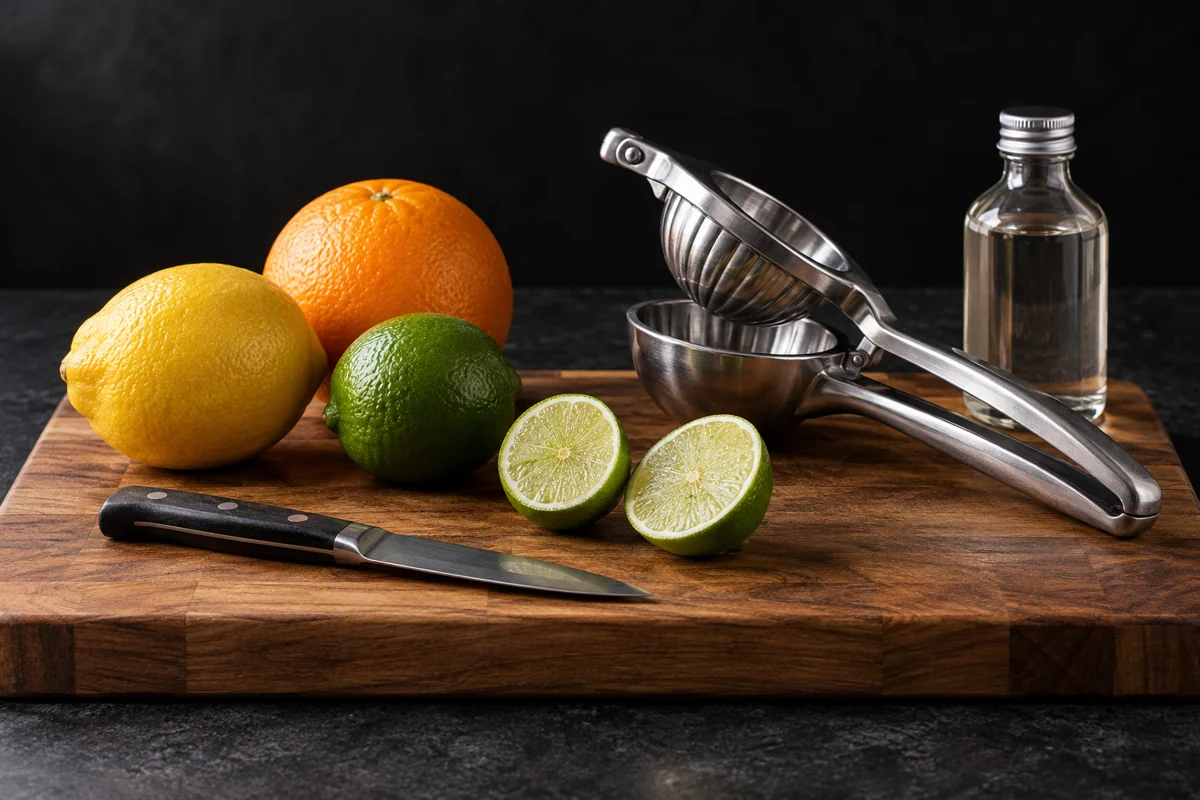
Citrus is both an ingredient and a workflow
A lime can contribute juice, a peel garnish or a wedge, but each use requires a deliberate preparation. Buying fruit by appearance alone does not tell you how much usable juice your menu will receive. Equally, a theoretical yield from someone else's kitchen may not match your fruit, equipment or technique. Plan from a small sample of the supply you actually have.
Start by listing the drinks that need citrus, their measured amounts and the expected demand. Then list garnish needs separately. This stops a common planning error: counting every piece of fruit as though it can simultaneously provide an untouched decorative peel, several perfect wedges and its full theoretical juice yield.
Begin with clean produce and a clear surface
FDA's produce guidance recommends washing fruit under running water before cutting and does not recommend soap or household detergents for produce. Wash even when the peel will be discarded, because cutting can transfer contamination from the outside. Use clean hands, tools and a preparation surface suited to the task.
For a commercial bar, follow its local food-safety procedures for preparation, cold holding and labeling. At home, follow relevant official guidance and product instructions rather than leaving prepared ingredients out indefinitely. This article does not give homemade juice a universal storage life. A date on a bottle is useful only when it is connected to an appropriate handling rule.
Fresh-squeezed juice is untreated unless it has undergone an appropriate process. FDA warns that untreated juice can carry harmful bacteria. For people at higher risk from foodborne illness, choose pasteurized or otherwise appropriately treated juice and follow the relevant official guidance.
Run a yield check instead of guessing
Take a representative group of fruit from the current purchase. Record the number or purchased mass, the cost and the usable juice produced with your normal equipment. Keep the measurement basis consistent. Note whether you strained the juice and how much was discarded with seeds and pulp. Your purchasing estimate should use the yield you can actually reproduce.
Imagine a purely illustrative trial in which a purchase costing 6 currency units produces 300 ml of usable juice. That is 0.02 currency units per ml, so a 25 ml portion costs 0.50 before any other allocated costs. The example is arithmetic, not a market price or a claim about how much a particular fruit should yield.
Repeat the check when the supply changes materially. A notebook with a few real observations is more useful than a confident single estimate that never gets revisited. In a venue, include the date and supplier so an unusual yield can be traced rather than treated as unexplained waste.
Specify the juice as it will be used
A recipe card should say which citrus is intended and whether the preparation includes a straining step. An undefined instruction to use sour mix hides too much information for original recipe development. If you use a commercial product, identify it accurately and follow its label. If you change the product, taste the complete cocktail before treating it as an equivalent substitution.
The IBA Daiquiri and Margarita both provide useful examples of recipes with measured lime juice. Their amounts offer reference points for those specific formulas, not permission to substitute an arbitrary lemon-lime blend. When you develop a variation, name it honestly and record the adjusted recipe.
Taste a small fresh sample for quality before using it in development, assuming it has been handled properly. Describe what you notice in useful terms: more sharply sour than the previous batch, muted aroma or an unpleasant bitter note. Such observations help guide a trial. They do not establish whether the juice is safe.
Plan the garnish before cutting everything
Choose garnish shapes around the actual glasses and drinks. A wedge intended to be squeezed by the guest has a different role from a small peel used for aroma. Establish the size and placement with a trial glass, then estimate the quantity. Cutting a mountain of decorative wheels without a service plan can create work and waste without improving the drink.
Keep yield categories honest. If you reserve visually suitable fruit for a particular garnish, record what remains available for other approved uses. Do not promise zero waste simply because you can imagine another application for the peel. A secondary use needs demand, safe handling and someone responsible for carrying it out.
For a small event, fewer garnish formats can simplify preparation. One well-chosen cut used thoughtfully across two compatible drinks may work better than a separate intricate design for every order. The guest should be able to understand and comfortably use the garnish without moving a sculpture out of the way.
Build a citrus prep sheet
A useful sheet combines demand, yield and the service specification. It does not need to be complicated, but it should let a second person prepare the ingredients without relying on memory. Keep the assumptions visible so you can revise them after service.
After the event or shift, compare the estimate with reality. Perhaps the garnish plan was generous while the juice estimate was tight, or one drink sold very differently from expectations. Use that specific finding to improve the next preparation. Citrus management becomes easier when you treat it as measurable work rather than a last-minute pile of fruit beside the shaker.
- List each juice and the measured amount required per planned serve.
- Record the actual usable yield from the current supply.
- Separate juice demand from garnish demand.
- Identify the preparation method, container and applicable handling instructions.
- Note product substitutions and any recipe adjustment approved after tasting.
- Record what was used, discarded or left over for review under the handling procedure.
Editorial method and review
Prepared with AI assistance by CocktailsPro Editorial using the primary references below. The examples and checklists are original editorial proposals, not reported hands-on tests. This draft needs human editorial review and, where applicable, practical tasting before publication. Research checked on 12 October 2026.