Cocktail Strainers: Hawthorne, Julep and Fine Mesh
Learn what each cocktail strainer does, how to check fit and when fine straining improves a drink rather than adding an unnecessary step.
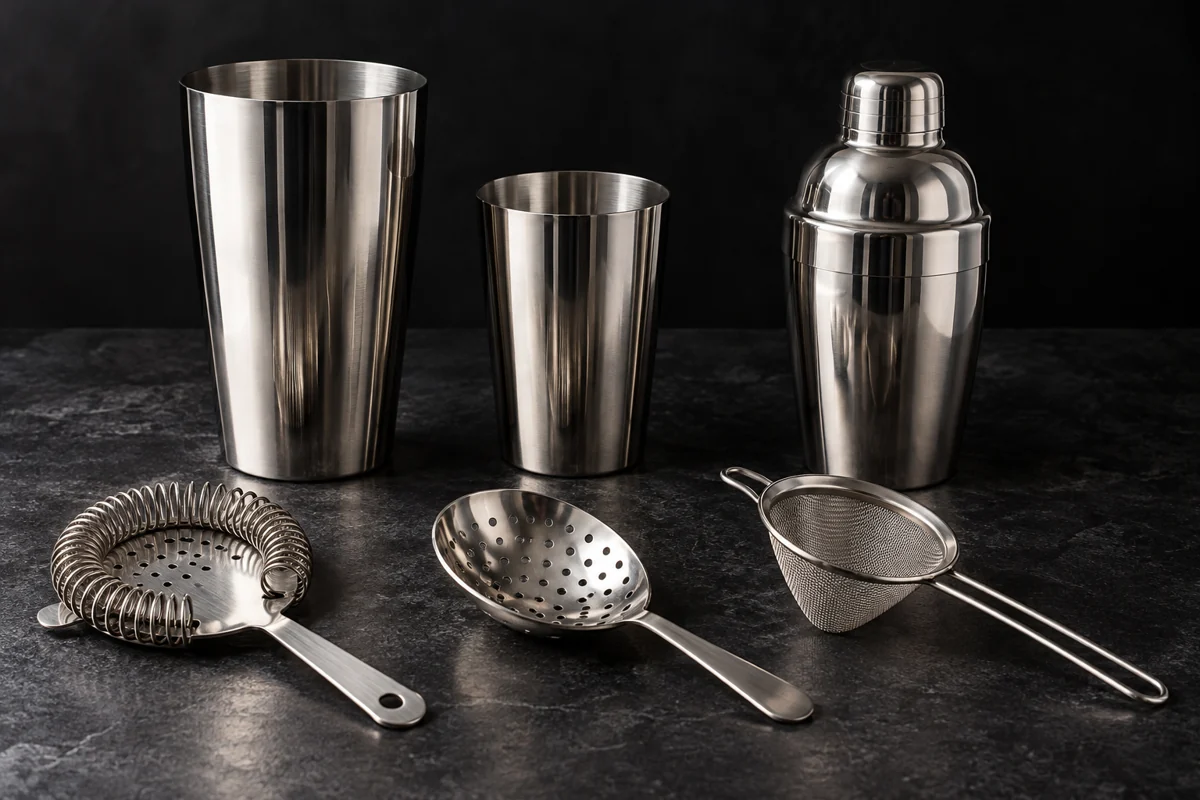
Start with what you want to leave behind
Straining is a choice about the finished drink. You might want to hold back the mixing ice, remove visible herb fragments or create a smooth surface without small ice chips. Those goals are related but not identical. Choose the tool for the result rather than applying the same elaborate sequence to every recipe.
A recipe that is stirred and strained, such as the IBA Dry Martini, needs a controlled way to separate liquid from mixing ice. A built drink served in the same glass may not require that step at all. Begin by reading the complete method, including the final glass and ice, before deciding how many strainers belong on the station.
Hawthorne: check the fit before the pour
A Hawthorne-style strainer has a spring around a perforated plate. The spring and body help it sit at the mouth of a suitable mixing vessel while retaining ice. Manufacturer descriptions often specify compatible tins or glasses. That information matters: a strainer that fits one vessel securely may be awkward on another with a different diameter or lip.
Practise the hold with water and ice. Keep the strainer supported and pour in a controlled stream into the center of the receiving glass. If liquid escapes around the edge, investigate fit and angle before increasing pressure. A strainer is not a lid you can assume will stay attached by itself. Your grip must remain secure throughout the pour.
Look at how the spring and other parts can be cleaned according to the maker's guidance. A tool with inaccessible residue is inconvenient for routine service. A visually elaborate finish also deserves a care check, particularly if your washing system is designed around plain stainless-steel tools.
Julep: a simple partner for a mixing glass
A Julep strainer is a perforated, spoon-shaped tool commonly used with a mixing glass. The cited manufacturer describes its example as fitting standard and larger mixing glasses. That does not guarantee compatibility with every vessel. Try the actual combination, especially if the glass has an unusual opening or a pronounced spout.
Seat the tool securely against the ice in the intended position and use a supported, controlled pour. The task is to retain the solids while allowing the prepared liquid to leave cleanly. Do not turn the choice between a Julep and a Hawthorne into a test of bartending status. If the tool fits, works with the recipe and can be used consistently, it has met the practical brief.
Fine mesh: a second stage with a clear purpose
A small mesh strainer can catch finer particles after the main strainer has retained the larger ice. Cocktail Kingdom's mesh specification explicitly describes filtering ice chips and pulp. The practical application is straightforward: use it when those particles are unwanted in the intended drink. A fine strainer is not a general purification device and does not make unsafe ingredients safe.
Position it over the receiving glass without letting it sit in the finished drink. Pour steadily and give liquid room to pass through. If the mesh becomes blocked, stop and manage the obstruction rather than forcing everything through. Excessive pressing can defeat the texture you were trying to achieve by pushing the retained material into the glass.
Double straining also adds handling and cleanup. Include it when a comparison shows a worthwhile result, not merely because the extra tool looks professional. For a drink deliberately served with fruit or crushed ice, removing every visible particle may contradict the recipe's intended character.
A troubleshooting clinic
If ice slips past the strainer, first check whether the tool is suited to the vessel and whether the pour angle creates an open gap. If the stream sprays or splits, reduce the pouring speed and inspect the position. If the drink takes too long to pass through a mesh, reconsider the amount of pulp entering it and the condition of the tool.
If the final volume seems low, check what remains in the tins and strainers before changing the recipe quantities. Fine filtration can leave liquid with the retained solids. Document the practical yield you achieve in development instead of quietly adding extra spirit to fill the glass. Volume, texture and portion strength need to stay connected.
For repeated problems, run a water-only rehearsal at the actual station. It may reveal that the receiving glass is too far away, the mesh has nowhere stable to rest or the strainer requires an uncomfortable grip. Moving one item can be more useful than buying a more ornate tool.
Make straining part of the recipe card
A clear instruction names the intended result and the necessary action. Strain into a chilled coupe is different from fine strain into a chilled coupe or pour with the crushed ice. Avoid relying on an unwritten house habit when training a new person.
The best straining sequence is usually the simplest one that reliably delivers the designed texture. Once the fit and movement are dependable, the tool should disappear into the workflow and leave the guest with a clean, comfortable drink.
- Identify the mixing vessel and compatible primary strainer.
- State whether a second mesh strainer is needed.
- Describe the finished glass and any fresh serving ice.
- Include tool cleaning in the service routine.
- Follow the venue's allergy procedures when equipment is shared between recipes.
Editorial method and review
Prepared with AI assistance by CocktailsPro Editorial using the primary references below. The examples and checklists are original editorial proposals, not reported hands-on tests. This draft needs human editorial review and, where applicable, practical tasting before publication. Research checked on 12 October 2026.